
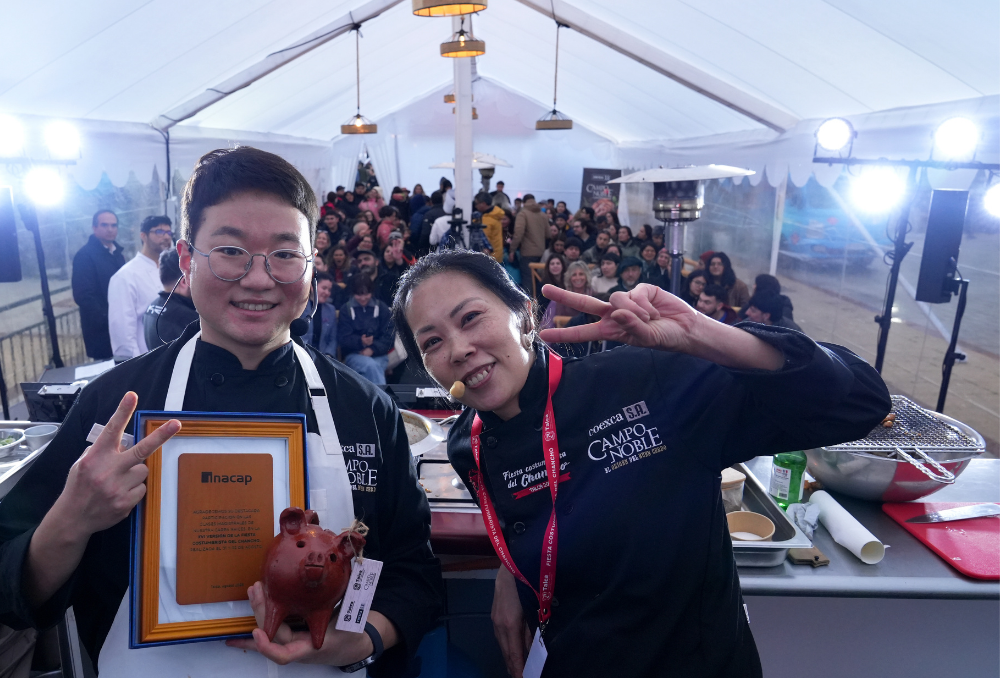
Chef Seyoung Park of Gold Pig Restaurant in Seoul and Helena Lee, a Korean chef based in Chile, led a master class at Talca’s Fiesta Costumbrista del Chancho, introducing the public to South Korean cuisine and highlighting the regard for of Chilean pork in one of its primary export markets.
Talca’s town square welcomed thousands for the traditional Fiesta Costumbrista del Chancho. Korean cuisine was a highlight of the festival, featuring a master class by Seyoung Park, executive chef and head of Research and Development at Gold Pig Restaurant (@gold_pig1982), one of South Korea’s most renowned pork restaurants. Chile has become the country’s fourth-largest supplier of pork, a staple of its cuisine.
He was joined by Helena Lee (@cocinando_con_helena_lee), a South Korean chef based in Chile who is a key advocate for Korean cuisine and the founder of the Kot Kiosko restaurant (@kotkiosko). Both chefs prepared traditional Korean recipes using two cuts preferred by Korean consumers: jowl and belly. These cuts represent a significant share of Chilean exports to that market.
The event drew an audience that closely followed each step of preparation, asked questions about the ingredients and techniques used, and learned firsthand how traditional Korean recipes can be made using pork produced in Chile. Attendees were especially curious about ingredients like gochujang, a traditional fermented chili paste, because of its use and how it enhances the flavor of pork.
The class combined food, culture, and education, shedding light on why South Korea has become one of the most important markets for Chilean pork exports. Helena Lee, who has spent years promoting Korean cuisine in Chile, bridged the two cultures by introducing the audience to traditional techniques, ingredients, and recipes from her country.
In addition to connecting with the public through culture, the master class was a valuable professional opportunity for Lee. «It was a great experience, cooking with a chef who brings an innovative perspective to traditional preparations. This exchange allowed me to learn new ways to approach Korean cuisine, update my techniques, and, at the same time, enrich my knowledge from a different perspective,» she noted.
Korean-style jowl and belly
During the class, Park and Lee prepared two traditional Korean dishes using pork jowl and belly, explaining each step and drawing parallels between Korean and Chilean cuisines.
The first was hangjeongsal-gui, a dish of grilled pork jowl dressed in soybean paste that highlights the flavor and distinct texture of this cut.
The second was budae-jjigae, also known as «army stew,» a popular Korean dish with a bold flavor that combines vegetables, cold cuts, and other ingredients. For this version, the chefs added stir-fried pork belly, sharing a different way to cook and enjoy this cut. Lee recounted how the dish became popular in South Korea after the war and a staple among soldiers.
The Gold Pig Restaurant Experience
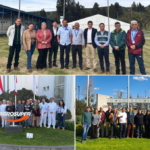
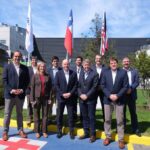
As part of his visit to Chile, chef Seyoung Park toured the Coexca plant with Sukyung Bak, founder, CEO, and creator of Gold Pig Restaurant. They learned firsthand about the Chilean pork production process and the main cuts exported to the Korean market. Pork belly is a favorite for Korean grilling and a staple ingredient at the restaurant. They saw the origin and quality of the product that reaches South Korean dinner tables.
Sukyung Bak (Park Soo Kyung) is a renowned food entrepreneur in South Korea. Since 2009, she has created, developed, and scaled several restaurant brands, with Gold Pig being the most successful. She leads the brand’s business strategy, positioning, and international expansion.
Founded in 2016 in the Sindang-dong neighborhood of Seoul, Gold Pig Restaurant has become a benchmark for Korean cuisine specializing in pork, thanks to the careful selection of premium cuts, the use of charcoal, and a precise grilling technique that earned it Bib Gourmand recognition from the Michelin Guide for eight years in a row.
«Visiting Coexca’s processing plant in Chile and preparing the culinary demonstration with ChilePork made me realize something important: it is surprisingly similar to Korean pork. By visiting the plant firsthand, I saw the rigor and precision with which they handle product specifications for Korea. In addition to traditional cuts like pork belly, jowl, shoulder, and collar, they produce an array of cuts specifically developed to suit our cuisine. It was surprising to see how integrated ChilePork is into Korean cooking,» Park noted.
One aspect that most caught the chef’s attention was the processing of the belly’s soft cartilage. «In Korea, this cartilage is not usually extracted as a separate product, whereas in Chile it is cut and processed as an independent piece. When cooked slowly for a long time, it becomes soft and chewable, similar to doganitang, a soup made with beef knee cartilage. Seeing this inspired me with a completely new idea for a dish, something that would be very difficult to pull off using Korean cuts alone,» he commented.
South Korea, a strategic market for Chilean pork
Pork belly was chosen for this class due to its special importance in both Korean cuisine and Chilean exports. In 2025, belly accounted for 64% of the value and 58% of the volume of Chilean pork exports to South Korea. Together with the collar, these two cuts represented 82% of the value and 78% of the volume Chile shipped to that market.
During the same period, Chile also consolidated its position as the fourth-largest pork supplier to South Korea, behind the United States, Spain, and Canada. Of the more than 36,000 tons of frozen boneless pork exported by Chile to South Korea, about 21,000 tons were pork belly.
The importance of this market is also reflected in its consumption habits. In South Korea, pork consumption is close to 30 kilograms per person per year, surpassing chicken and beef.
The master class in Talca took the relationship between Chile and South Korea into the kitchen, offering food, cultural exchange, and knowledge of a market where Chilean pork has an increasingly significant presence.