

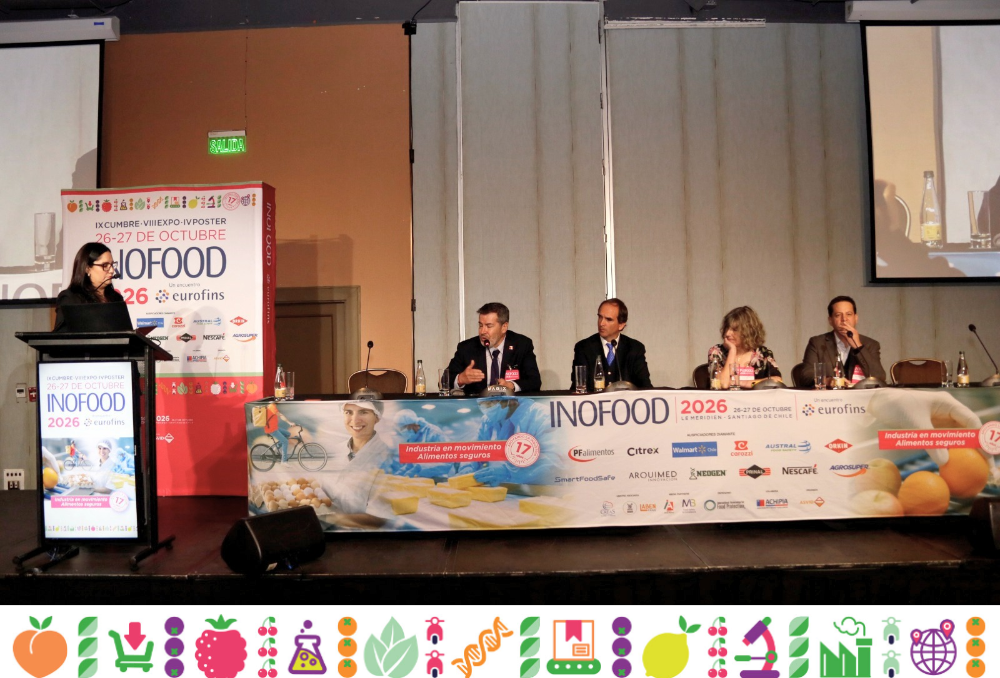
During a panel discussion that brought together representatives from across the food chain to analyze the changes shaping its future, ChileCarne’s President Juan Carlos Domínguez addressed the health challenges facing the meat sector. In his presentation, he emphasized that prevention and biosecurity are the cornerstones of safeguarding animal health and protecting Chile’s export capacity.
What do a pig farm, a migratory bird, and a suitcase arriving from abroad have in common? Though they seem very different, they can all pose a threat to animal health. ChileCarne’s President Juan Carlos Domínguez posed this question during INOFOOD 2026, an international conference on food safety, quality, and innovation held in Santiago on October 26 and 27.
The panel, titled «What Will Drive the Industry? —A Look from Different Perspectives,» brought together representatives from across the food industry. Panelists included Enrique González, Corporate Food Safety Manager at Carozzi Foods; Alicia Gallardo, President of the Aquatic Animals Commission at the World Organization for Animal Health (WOAH); Pedro Bouchon, Director of the NOVA-IA consortium and Full Professor at the Catholic University of Chile; and Osvaldo Artaza, Director of Compliance at Prelafit Compliance. The discussion examined the transformations shaping the sector and how to prepare for future challenges.
Speaking on behalf of the meat industry, Juan Carlos Domínguez emphasized the need to protect the animal-health standards that Chile has built over decades, which have enabled the establishment of a competitive export sector with a presence in demanding international markets.
Health risks know no borders
In his presentation, «The Challenges of Producing Safe Food from Farm to Consumer,» ChileCarne’s President discussed the evolution of Chile’s pork and poultry sectors. Export growth in these sectors has been closely linked to improvements in biosecurity, animal health, food safety, and traceability.
These advances are the result of decades of investment and collaboration between the sector and the Agricultural and Livestock Service (SAG). This partnership has enabled the development of a model to meet the health requirements of destination markets. However, maintaining this legacy requires constant vigilance, particularly in the face of threats that could quickly undermine capabilities built over many years.
Domínguez emphasized the need to anticipate risks that can enter the country through various channels, including the international movement of people and goods, as well as migratory birds. Therefore, prevention must begin long before animals enter a farm and include border protection measures, wetland surveillance, and actions to reduce risks associated with supplies from countries affected by diseases such as African swine fever (ASF).
Additionally, the President of ChileCarne discussed initiatives to strengthen disease control measures for small-scale poultry farmers and to expand prevention capabilities beyond production facilities. The goal is to address threats at their source to prevent them from compromising animal health and the production system.
Oversight and inspection throughout the entire supply chain
Prevention is complemented by surveillance and control measures at multiple stages of production. Juan Carlos Domínguez highlighted an approach that integrates 16 public-private programs across the supply chain. These programs include contaminant monitoring, microbiological and waste testing, market audits, traceability measures, and other health inspections.
This comprehensive approach strengthens prevention and verifies compliance with health requirements through stakeholder coordination. It also enables a response to potential contingencies through collaboration between the meat industry and SAG, including zoning measures when appropriate.
Combining prevention, surveillance, and response is essential to safeguarding the health of domestic production and maintaining the standards that underpin access to international markets.
A key health asset for the export sector
The importance of protecting animal and plant health is reflected in the sector’s economic significance. According to figures from ChileCarne, pork, chicken, and beef make up Chile’s fourth-largest food export sector, with exports totaling approximately $1.35 billion USD in 2025. Maintaining the health standards that enable access to international markets is essential to safeguarding this position and ensuring continued export growth.
ChileCarne’s participation in INOFOOD 2026 underscored that producing safe food requires ongoing efforts that begin long before meat reaches consumers. To protect the country’s animal and plant health and ensure the continued growth of Chile’s pork and poultry sectors, it is essential to stay ahead of threats, strengthen surveillance, and maintain public-private partnerships.