
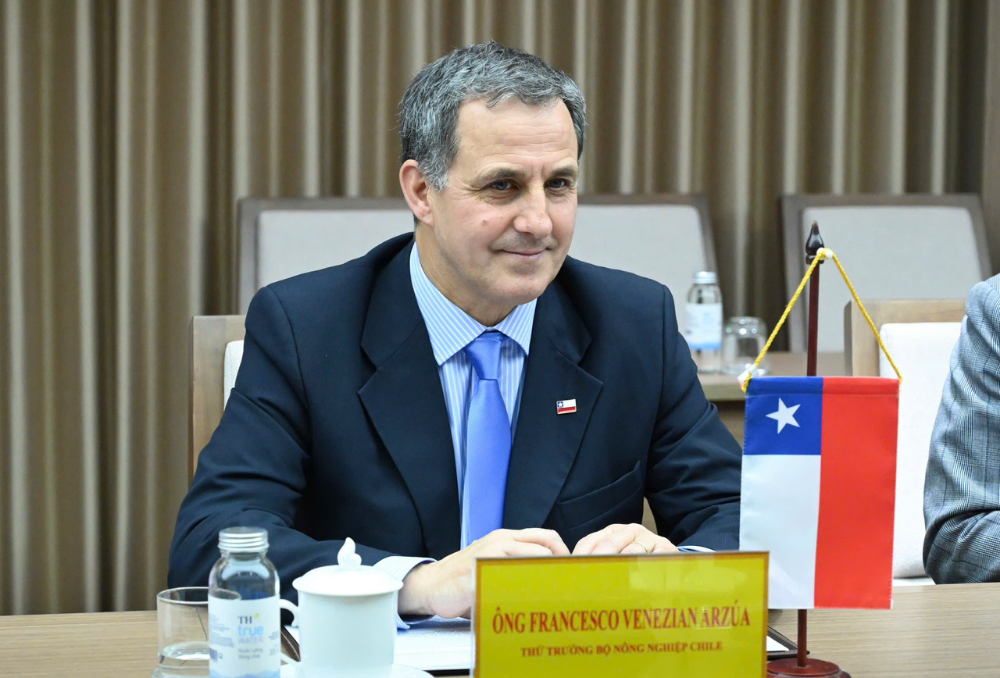
Fresh from a tour of China, Vietnam, and Indonesia, where he was accompanied by Chilean food industry associations including ChileCarne, Fruits from Chile, and the Chilean Meat Packers Association (Faenacar), the Undersecretary of Agriculture, Francesco Venezian, analyzes the progress and challenges in strengthening Chile’s presence in these strategic markets. In conversation with ChileCarne, Venezian addresses market access, zoning, and market diversification, as well as the importance of technical knowledge and business experience to strengthen dialogue with authorities and advance sanitary access, in line with the needs of each market.
-The tour included visits to China, Vietnam, and Indonesia. What are the Ministry of Agriculture’s main objectives in those markets, and what specific opportunities exist for Chilean meat exports?
Our main goal was to strengthen the international presence of the Chilean forestry and agricultural sectors, consolidate strategic markets, and improve access for our agri-food products. In China, Vietnam, and Indonesia, we hope to deepen dialogue with animal health authorities, strengthen technical cooperation, and advance market access, sanitary and phytosanitary requirements, and trade facilitation.
For meat exports, it was an opportunity to continue our efforts to expand and diversify access to Chilean livestock products, particularly by making progress on technical matters with the authorities of the countries we visited. In China, we are promoting access for new products, zoning systems, and e-certification.
In Vietnam and Indonesia, the tour helped us strengthen relations and follow up on ongoing efforts to open and ease trade. The objective was to continue efforts to diversify Chilean meat export destinations by reaching high-potential economies, supported by technical cooperation between the relevant authorities.
–Vietnam is considered to have significant potential for Chilean meat. What progress does the government expect in obtaining sanitary approvals, and how close are we to seeing Chilean pork and chicken access that market?
We have identified Vietnam as a strategic market to further diversify Chilean agri-food exports in Asia, particularly for our meat sector.
In 2024, we made a major step forward: after 14 years of waiting, Vietnamese inspectors visited our plants. This was thanks to technical progress made by SAG, the Chilean Agricultural Attaché in Vietnam (operational since 2024), and the Vietnamese animal-health authorities.
After exchanging technical information, we are drawing up the official documentation required to open the Vietnamese market to our pork, poultry, and beef producers. One of the goals of this visit was to advance the process and lay the foundations for authorization. We underscored the importance of swiftly finalizing this process to Vietnam’s Vice Minister of Agriculture.
Chile has an internationally recognized animal health system, a highly mechanized industry, and extensive export experience. We want to build on these strengths to make progress with Vietnamese authorities in the remaining stages of authorization.
This tour was an opportunity to convey that Chile is ready to move forward with the opening, raise the issue at the political level, and support the technical work led by SAG.
-China remains a strategic market for Chilean meat. What issues did you address during the tour to further strengthen the presence of Chilean products in that country?
We addressed various issues related to expanding and improving the stability of meat access conditions. For example, we made technical progress to expand access to new poultry and pork products, as well as to beef and lamb by-products. We also expressed Chile’s intention to formally open talks on a zoning agreement for African swine fever, which would safeguard the continuity of bilateral trade in the event of animal health emergencies.
Finally, we addressed how to facilitate agri-food trade, particularly through animal health e-certification, traceability, inspections, and coordination between animal health and customs authorities.
The visit strengthened relations and advanced these initiatives The technical counterparts of our countries are in constant communication and Chile is ready to use the appropriate channels to move forward on matters of interest to China and our country. The goal is to continue consolidating a long-term animal-health and trade relationship based on technical cooperation, trade facilitation, and mutual benefit.
-Joint efforts from the public and private sectors have been key to opening and consolidating international markets. What do you think of that collaboration, and what role did it play during this tour to advance new agreements?
There is no doubt that this public-private collaboration is one of the key factors explaining Chile’s international standing as a reliable food supplier. The opening and consolidation of markets is not due to the work of a single institution but to the ongoing collaboration between the Ministry of Agriculture, SAG, ODEPA, the Ministry of Foreign Affairs, and the production and export associations, which help advance a long-term common vision.
This coordination has been instrumental in building trust with our counterparts, responding to increasingly strict animal health requirements, and developing internationally recognized traceability, certification, and food safety systems. It has also enabled us to respond promptly to health emergencies and adapt our export offer to the needs of markets as diverse as those in Asia.
The tour made this collaboration clear. The delegation included representatives from major exporting sectors, such as Fruits from Chile, ChileCarne, and Faenacar, who contributed technical knowledge, business experience, and a direct view of the opportunities and challenges our exports face. This coordination strengthens dialogue with authorities in China, Vietnam, and Indonesia, enabling us to address sanitary market access approvals with robust technical data aligned with real market needs.
-Beyond this tour, what are the Ministry of Agriculture’s priorities to further strengthen the international competitiveness of the Chilean meat sector and open new opportunities?
Looking beyond the tour, one of the Ministry of Agriculture’s key priorities is to strengthen the international competitiveness of Chilean production industries, based on three pillars: a strong animal health status, opening and diversifying markets, and updating foreign trade processes.
First, we will continue to strengthen our plant and animal health assets, which is one of the country’s key competitive advantages. We have a robust animal health framework, strong traceability systems, and close collaboration between the public and private sectors, enabling us to meet the most demanding international standards and build trust with our trading partners.
We will also continue to drive an agenda focused on market opening and diversification. Our goal is to expand access to beef, pork, lamb, and poultry, as well as new animal products and by-products, especially in Asia, a region with enormous growth potential due to rising demand for quality protein.
Another priority is to update and digitize health and certification processes. Implementing e-certification and strengthening traceability reduce time and costs, increase transparency, and create a more secure and efficient trade environment. Digital transformation is now a key tool for improving our international competitiveness.
Our challenge is to get more Chilean products into more markets, contributing to the sector’s growth, job creation, and the development of rural areas.
-In a scenario where Asian markets have higher animal health, traceability, and sustainability requirements, what are the priority challenges for Chile to maintain and strengthen its position as a reliable supplier?
The main challenge is to continue strengthening the trust that Chile has built over decades in international markets. To do this, we must safeguard our plant and animal health assets, strengthen traceability and food safety, and update certification systems for greater efficiency.
At the same time, Asian markets are demanding higher standards in sustainability, transparency, and risk management, so we must continue to innovate, digitize, and improve production practices throughout the entire agri-food chain.
Chile has a significant advantage thanks to its robust animal health framework, close public-private collaboration, and a recognized capacity to meet the highest standards.
Our challenge is to continue strengthening these attributes to position ourselves as a reliable, competitive, and long-term supplier to Asia and the rest of the world.