
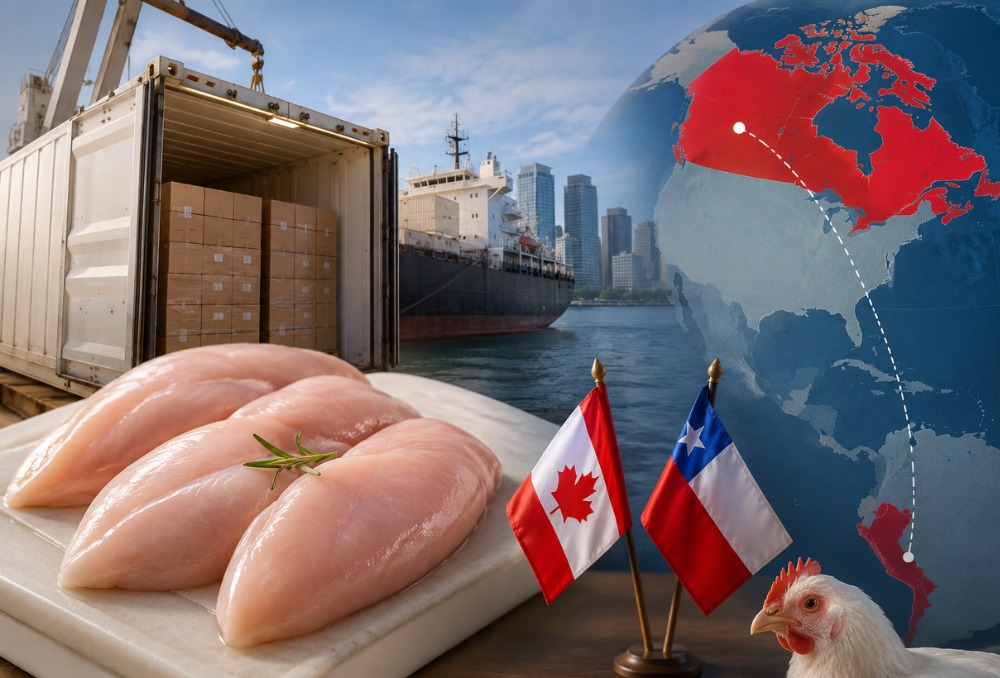
The CPTPP has opened new opportunities for Chilean exports. Canada has become a strategic market for poultry, driving sustained growth in shipments and positioning Chile as the primary supplier within the preferential tariff quota set by the agreement.
Three years after the Comprehensive and Progressive Agreement for Trans-Pacific Partnership (CPTPP) took effect in Chile, the poultry industry is an example of its benefits. Preferential access to the Canadian market has produced sustained growth for Chilean poultry, transforming Canada into one of the industry’s primary destinations.
The CPTPP is one of the world’s largest trade agreements, currently bringing together 12 economies from the Pacific Rim. Its goal is to promote economic integration, facilitate trade, and establish modern and predictable rules for the exchange of goods and services. The agreement has allowed Chile to improve access conditions to markets with existing bilateral treaties, creating new opportunities for sectors such as agri-foods, including pork and poultry.
According to the report, «Three years of the CPTPP in Chile,» released by the Undersecretariat for International Economic Affairs (SUBREI) in March 2026, the agreement has created concrete opportunities for many industry and export sectors. The report highlights progress in markets like Japan, Canada, and the United Kingdom, including an increase in pork exports to Japan and the consolidation of Chilean poultry in Canada. One of the biggest success stories is that of poultry, which has consolidated its presence in Canada thanks to the market access offered by the treaty.
According to figures from SUBREI, Chile used 96% of the preferential poultry quota allocated by Canada to CPTPP member countries in 2025, generating returns above US$54 million and becoming the primary supplier within the quota.
According to Juan Carlos Domínguez, President of ChileCarne, these results reflect years of work from the production chain to access and consolidate its presence in high-value markets.
«The entry into force of the CPTPP has meant a real opportunity for the sector. Today we see how a market as large and demanding as Canada has become a strategic destination for our poultry, thanks to the combination of better access conditions, high production standards, and Chile’s ongoing efforts to strengthen its international competitiveness.»
A market that provides new opportunities
Before the agreement, Chilean poultry exports to Canada were negligible. The preferential quota established under the CPTPP allowed Chilean companies to grow their presence in this market. Thanks to the agreement, Chile’s poultry exports enter Canada with a 0% tariff within the quota allocated to member countries, significantly improving its competitiveness against other international suppliers. There is also a zoning protocol for Avian influenza between the two countries, which helps safeguard the continuity of trade in the event of outbreaks and provide certainty and stability to exporters.
The results didn’t take long to be noticeable. In 2023, exports reached US$15.4 million; in 2024, US$28.6 million; and in 2025 they exceeded US$54 million. In terms of volume, shipments exceeded 22,600 tons during the last year.
Chile’s performance has also been recognized internationally. A report by the Foreign Agricultural Service (FAS) of the United States Department of Agriculture identified Chile as the country that has made the most of Canada’s CPTPP access opportunities for poultry, even over traditional suppliers like Brazil and Thailand.
For Domínguez, these results also reflect the importance of maintaining health conditions that provide stability to international trade.
«Opening markets is essential, but so is having high health standards and tools that provide certainty to trading partners. That has contributed to the growth we have seen in Canada.»
Three years after the entry into force of the Trans-Pacific Agreement, Chile’s poultry penetration in Canada has become one of the most concrete examples of how trade liberalization can translate into new opportunities for the agri-food sector. The sustained growth of exports, nearly full utilization of the available quota, and the market positioning achieved by Chile demonstrate the poultry industry’s potential to keep strengthening its international presence and contributing to the country’s export development.