
The use of slurry and other byproducts of animal husbandry as fertilizers helps reduce costs, improve soil quality, and mitigate environmental impact, making it a viable alternative to the rising cost of chemical fertilizers and a cornerstone of the circular economy in the agricultural sector.
Amid international volatility and recent increases in fertilizer prices, bio-inputs derived from manure and slurry have emerged as an efficient and sustainable alternative for agriculture. Their use helps reduce costs, improve soil quality, and move toward production systems based on the circular economy.
Not only do they supply nutrients, but they also improve soil quality and support the performance of agricultural systems. “These by-products provide essential nutrients for plants. They don’t look like conventional fertilizers, but they serve the same purpose in both the soil and the plant, with the added benefit of supplying carbon,” explains Juan Hirzel, a researcher at the Agricultural Research Institute (INIA).
These traits have driven the recovery of byproducts from livestock production—such as slurry, manure, and digestate—which now play an increasingly important role. Given the steady rise in fertilizer prices throughout 2026, particularly those of nitrogen-based fertilizers, bio-inputs have become a practical alternative for reducing dependence on imported supplies and stabilizing production costs.
In Chile, this has gone hand in hand with a profound transformation in how the pig industry manages slurry. In recent decades, there has been a shift from open tank storage systems to more advanced technologies, such as biodigesters, activated sludge plants, composting, and vermifilters. This change has meant that treatment coverage has increased from less than 40% in 1998 to more than 95% in 2023, which has had a positive impact on emissions reduction, resource efficiency, and the generation of byproducts of agricultural value.
How they are used and how the industry has changed
This development is not new. Chilean pig and poultry producers have spent years implementing circular economy practices, in which slurry management is an integral part of the production system.
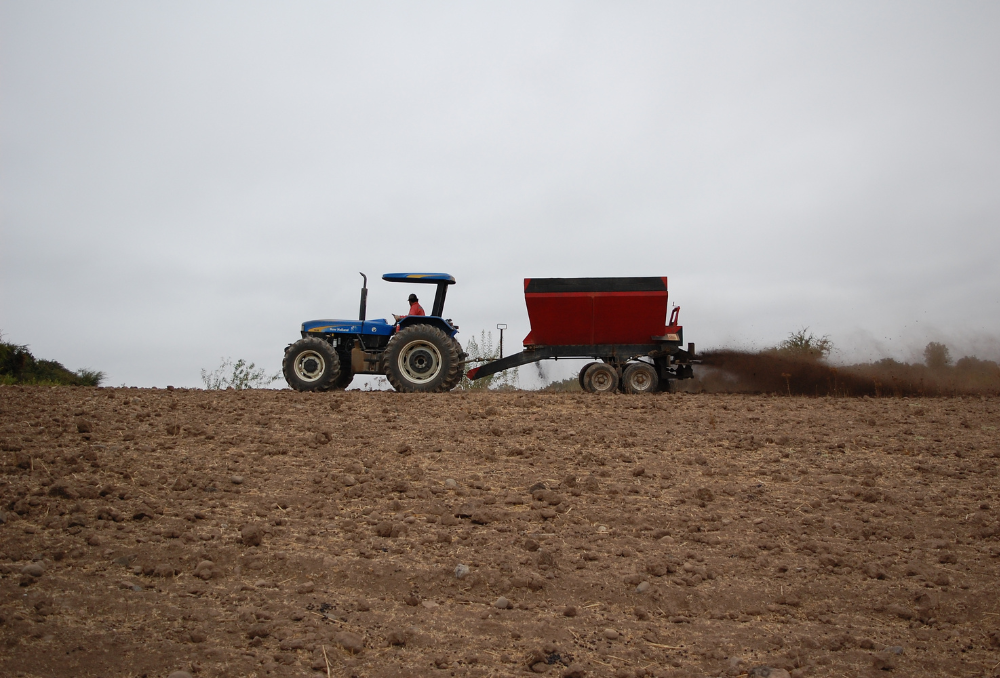
One of the most widespread practices is fertigation, which involves adding slurry and digestate to irrigation water—in accordance with agronomic plans—and using them as fertilizer. In parallel, more solid materials, such as bio-stabilized materials and manure, are used directly as fertilizer on agricultural soil.
The outcome is clear: these bio-inputs provide essential nutrients such as nitrogen, phosphorus, potassium, magnesium, and calcium, along with organic matter, a key component for improving the structure and health of agricultural production systems.
Advanced treatment systems have also had a significant impact on the sector’s environmental performance. According to ChileCarne’s Sustainability Report, nitrogen emissions per production unit have fallen by around 75% since the early 2000s, mainly thanks to technologies such as activated sludge and vermifilters, which convert reactive compounds into inert ones.
There has also been progress in water efficiency. Fresh water use at plants has been reduced by nearly 69%, largely due to increased recirculation of treated water in processes such as cleaning. At the same time, slurry generation per production unit has also decreased, which reflects more efficient operations.
Another key factor has been the introduction of biogas digesters, which treat slurry while simultaneously generating biogas. Biogas is used as an energy source in a variety of processes, substituting fossil fuels in applications such as heating, industrial processes, and in some cases, electricity generation.
Beyond fertilization: improving the soil
Although bio-inputs derived from slurry serve a similar purpose to traditional fertilizers—by providing essential nutrients for crops—their benefits go a step further, as they also have a direct impact on agricultural soil.
Their carbon content sets them apart from synthetic fertilizers. These materials help boost organic matter, which improves soil structure, its ability to retain water and nutrients, and promotes biological activity. In other words, they not only nourish the crops, but also improve soil health over time.
At farms, these effects are clearly visible. Esteban Hidalgo, farm manager at Santa Macarena in the municipality of Santo Domingo, says that organic amendments have made it possible to “improve soil structure and take advantage of organic byproducts that provide nutrients.”
In his experience, these inputs have proven effective when applied to fruit trees and annual crops, resulting in improved crop performance, greater biological activity in the soil, and significant cost savings.
The evidence supports these effects. Consistent use of organic amendments improves soil fertility and productivity, leading to better crop yields.
“Organic fertilizers, which are rich in carbon, not only deliver nutrients but also improve soil quality and its productive capacity over time. This leads to more sustainable agricultural systems,” adds Hirzel.
He also debunks some widespread myths. “Some think that organic amendments cause soil salinization or acidification, but in practice the opposite is true. They can even help improve these conditions,” he points out.
Cost-effectiveness and environmental benefits
In addition to their agronomic benefits, bio-inputs are good business, especially when fertilizer prices are high. Since the products are locally sourced, the costs associated with importing, transporting, and marketing them are lower.
“Today, the direct cost of fertilization with organic amendments can be about 50% of that of conventional fertilizers,” Hirzel notes.
From an environmental perspective, their use also helps reduce greenhouse gas emissions. When added to the soil, some of the carbon content in these materials is sequestered, helping to improve soil health and reduce the carbon footprint of farming systems.
There is also an additional benefit in terms of water efficiency: in systems such as fertigation, slurry can help provide part of the water needed by crops, thereby optimizing water use at farms.
Challenges and opportunities
Despite their many benefits, the adoption of bio-inputs still faces challenges, largely related to the need for greater knowledge and technology transfer to farmers.
It is currently estimated that between 15% and 20% of the country’s agricultural land uses organic soil amendments, a figure with great potential for growth.
“The main challenge is education and outreach. It’s not enough to simply spread the word; we need to show farmers how these products work in the field so they can see the results for themselves and use them with confidence,” says Hirzel.
In this regard, on-the-ground experience has also shown the importance of technical support for their adoption. Esteban Hidalgo explains that these inputs are being implemented based on laboratory analyses and quality reports, which ensures their traceability and builds greater confidence in their use.
Under these circumstances, the development of biorefinery models opens up new opportunities. These systems make it possible to convert slurry, manure, and other waste into fertilizers, energy, and new value-added products.
The goal is to move toward a model in which waste is no longer a problem but a resource, closing loops and strengthening the long-term sustainability of the agricultural sector.