


The management of the recent avian influenza outbreak in Chile, together with international evidence and studies by the World Organization for Animal Health (WOAH), underscores the importance of health zoning in containing diseases, safeguarding production, and ensuring the continuity of foreign trade. This tool is key in highly sensitive public health situations, such as avian influenza—with which the country has recent experience—as well as African swine fever and foot-and-mouth disease abroad.
Following confirmation of the case on March 24 at a commercial layer farm, the Agricultural and Livestock Service (SAG) promptly activated the prescribed measures, including the preventive suspension of poultry export certification and the timely notification of trading partners and WOAH. In coordination with the authorities, the private sector simultaneously implemented the Contingency Plan, strengthening biosecurity measures and activating territorial oversight mechanisms.
This response enabled Chile to resume shipments to key markets such as the United States, Puerto Rico, Mexico, and Canada in less than 72 hours—destinations that together account for 82% of the value of its chicken exports. The rapid reopening was made possible not only by the response to the outbreak, but also by the trust placed in Chile’s health system and the effective implementation of zoning.
The president of ChileCarne, Juan Carlos Domínguez, underscores the strategic role of sanitary zoning in addressing emergencies such as these without impacting exports. “It is a crucial tool for ensuring export continuity, as it prevents a localized incident from affecting the country’s overall shipments,” he says.
Territorial oversight and coordinated public health response
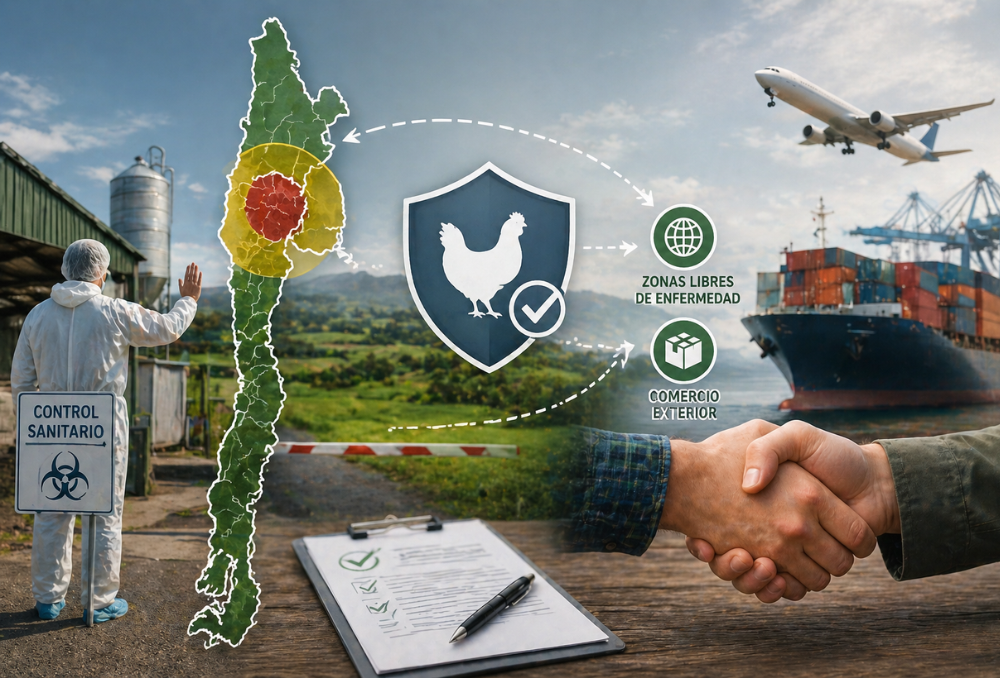
Health zoning entails demarcating geographic areas affected by a disease and implementing specific control measures in those areas, while unaffected zones continue to operate under normal conditions. This allows risks to be managed in a targeted manner, preventing a single outbreak from affecting the entire country’s production.
In Chile, zoning is implemented through sanitary agreements that allow exports from disease-free zones to continue, thereby safeguarding the industry’s operational continuity. In practice, the zone around the outbreak is placed under strict surveillance measures, movement restrictions, and health inspection, while the rest of the country continues to function normally.
The criteria vary depending on the destination market: while the United States, Puerto Rico, Canada, and the European Union use a 10-kilometer radius from the outbreak, other markets such as Mexico and the United Kingdom operate under regional or provincial schemes. This flexibility responds to the different levels of risk assessment in each importing country.
Zoning enables an effective public health response while simultaneously safeguarding production, biosecurity, and export continuity. It is also part of a broader public health framework that can be applied to other high-impact diseases—such as African swine fever or Newcastle disease—subject to approval by the destination markets.
International evidence and barriers to implementation
Chile’s recent experience is consistent with the findings of various international studies. The report “Use, challenges and impact of zoning and compartmentalization” (2024), published by WOAH, concludes that zoning is a key tool for balancing disease control with safe trade, particularly in the case of high-impact diseases such as avian influenza, African swine fever, and foot-and-mouth disease.
Zoning has become an increasingly widespread practice worldwide. According to the same study, adoption has grown steadily over the past few decades, rising from about 40% of countries in 2005 to more than 65% in 2021. Its use is particularly prevalent for diseases such as avian influenza, where it is used in over 70% of cases, and it has also been gaining ground for diseases such as African swine fever and foot-and-mouth disease.
The report also notes that, while zoning has proven effective in containing outbreaks and sustaining international trade, its success depends on enabling circumstances that go beyond mere regulations. Factors such as capable veterinary services, disease surveillance systems, animal movement control, and public-private partnerships are critical to their successful implementation. More than a strictly technical tool, zoning reflects a country’s institutional capacity and its international health credibility.
Recent events in Europe back up this assessment. Regarding African swine fever, countries such as Spain have had to strengthen their surveillance and preventive zoning systems in response to the spread of the disease to other parts of the continent, while nations such as Germany and Italy have implemented strict zoning measures to contain outbreaks in wild boars and prevent their spread to pig farms, thereby safeguarding their access to international markets.
These cases demonstrate that zoning is not simply a reactive measure but also a preventive tool. Its effectiveness depends largely on recognition by importing countries, as well as on trust in a country’s health system.
In the case of Chile, these circumstances are supported by a robust health system led by SAG, with well-established capabilities in disease surveillance, animal movement control, and public-private partnership. In addition, the country has a track record of compliance with health regulations and a trusted relationship with international markets, which has earned recognition for measures such as emergency zoning.
Juan Carlos Domínguez notes that “zoning is effective when there is a robust health system, seamless coordination between the public and private sectors, and long-standing credibility in the eyes of international markets.”
The recent handling of the avian influenza outbreak in Chile confirms that, when these measures are in place, it is possible to contain disease outbreaks, thereby preventing major impacts on production and foreign trade. At the same time, it underscores the need to further strengthen these systems, given that animal diseases continue to pose a growing challenge to global food security and trade flows.
Health zoning: An essential tool for aligning health oversight with foreign trade
Últimas publicaciones
-
 Biotechnology and meat production: Challenges facing the pork and chicken industries
 -
 Agri-Food Export Council addresses challenges and opportunities for agricultural exports
 -
 ChileCarne addresses new challenges related to dioxins, PFAS, and new contaminants at international meeting in Italy
 -
 ChileCarne works with the Ministry of Health to raise minimum temperature for frozen meat
 -
 Chile makes progress on health authorization in Indonesia, opening new opportunities for pork and chicken
 -
 Visit by U.S. officials highlights trade and production ties with Chile