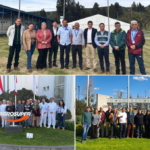


In an interview with ChileCarne, the Undersecretary for International Economic Affairs (SUBREI) analyzes the global outlook for Chilean exports, highlighting the opportunities offered by Asia, India, and Southeast Asia for Chilean meat and foodstuffs. She also discusses the progress of trade negotiations with strategic markets, the importance of health zoning, the challenges associated with new sustainability and traceability requirements, and how trade agreements strengthen the competitiveness and diversification of Chile’s export portfolio.
In a global scenario marked by geopolitical tensions, shifting trade flows, and new regulatory requirements, how do you see Chile’s position as a food exporter, and what are the most promising opportunities for continued growth in international markets?
Chile already has a strong position, and we are working to keep it that way. As of 2025, we have become the world leader in exports of 25 product categories, including fresh cherries, plums, hazelnuts, and salmon fillets. From January through May 2026, total exports of goods reached a new all-time high of $49.565 billion USD, a 12% increase from last year. This period also saw non-traditional exports—which include a large share of agri-food products—reach a record high of $22.15 billion USD. The food industry kept up with this upward trend, reaching a new export sales record of $5.979 billion USD, which is 3.3% higher than the same period last year.
Geopolitical tensions and changing trade patterns create challenges, but also opportunities. With a network of 36 trade agreements that cover nearly 89% of global GDP and a proven reputation for health management, Chile is well-positioned to fill gaps that other suppliers cannot. The challenge is to take full advantage of this platform by offering greater value and being able to adapt to the demands of each market.
Market diversification has been an ongoing priority for Chile. Which regions and markets currently show the most promise for Chilean agri-food exports?
Asia remains the most dynamic region for Chilean agri-food exports. China, Japan, and South Korea are well-established markets, but there is room for further growth in terms of value and product diversity. In Japan, Chile was the leading supplier of 30 products in 2025, dominating the high-value seafood sector and maintaining a significant presence in fruits and agricultural products. In the case of South Korea, the relationship has strengthened over the years, and it is a highly demanding market where Chilean products are well received.
India is also a promising opportunity, as the world’s fifth-largest economy, with more than 1.4 billion people and a growing middle class. It currently buys about 5% of Chilean exports, indicating significant potential for further growth.
Southeast Asia is also a key focus for us, with very promising markets such as Vietnam, Indonesia, and the Philippines. We are also keeping an eye on emerging markets in the Middle East and Africa, which are gradually becoming important destinations for agri-food exports.
Logically, all of this is being done in parallel with efforts to strengthen and deepen trade with our two main partners: China and the United States.
Asia has become a strategically important region for Chile. What are SUBREI’s priorities for strengthening the market presence of Chilean products in countries such as Japan, South Korea, and Southeast Asia?
With Japan and South Korea, we enjoy long-standing trade ties and have agreements currently in force. Our relationship with Japan has become even stronger since the CPTPP entered into force, complementing the existing bilateral Economic Partnership Agreement. With South Korea, our Free Trade Agreement has been the foundation of a relationship that has continued to evolve. In both cases, the focus today is better leveraging the agreements already in place, looking for opportunities to update them, and improving market access for Chilean products.
In Southeast Asia, our efforts are multifaceted. We have ongoing negotiations with the Philippines to reach a Comprehensive Economic Partnership Agreement (CEPA); we are making progress toward joining the RCEP, the world’s largest trade agreement; and we have the CPTPP, which includes key economies in the region and has positioned the bloc as our third-largest trading partner in just three years since its entry into force. The goal is to expand market access and ensure that Chilean producers can compete on favorable terms against suppliers from third countries that already have agreements with those markets.
Chile has made headway in trade negotiations with key markets such as the Philippines and India: What is the current status of these talks, what are the main challenges that still remain, and what are the prospects for when they will be finalized?
Both negotiations are ongoing and at different stages of progress. We have had four rounds of in-person talks with India, and a number of chapters have been finalized, so we are in the home stretch. A few weeks ago, we had a very productive visit there with the Minister of Foreign Affairs, which helped move the talks forward and shed light on the issues that have not yet been resolved and that are of greatest interest to us—primarily market access. It is a highly demanding process, because the goal is to reach a balanced agreement that provides real benefits for Chile.
With the Philippines, we have held four rounds of talks, and progress is being made on the main chapters. As with any negotiation of this nature, the process requires time and technical expertise. There is a clear commitment to moving forward in both countries. Moving forward on this deal is also important because the Philippines is one of ASEAN’s major economies, and Chile does not have a preferential trade agreement with it.
What specific opportunities might these agreements open up for food and meat exporters once they take effect?
Both India and the Philippines are markets with a high demand for proteins and agri-foods, categories in which Chile currently has a strong presence. With a successful CEPA, market access would substantially improve for the entire export basket, including meat, dairy products, and processed foods, which currently compete at a disadvantage against suppliers with preferential agreements.
International markets have increasingly higher standards in terms of sustainability, traceability, and responsible production. How can Chile turn these challenges into a competitive advantage?
International markets are demanding more and more that products come with verifiable information about their origin, production conditions, and environmental impact. These demands are not going to decline, and Chile is well-positioned to respond to this challenge and meet the highest international standards. In 2025, Chile was ranked as the world’s largest exporter in 25 product categories and had 54 goods ranked among the top three in global rankings. Our leadership is not based solely on volume, but is built on our reputation for excellent health practices, consistent quality, and compliance with rigorous standards.
Chile has actively promoted the recognition of health zoning as a tool for safeguarding the continuity of international trade in the event of health emergencies. With regard to pork, what progress have you seen in discussions with strategic markets such as Japan, South Korea, and China, and how important would their recognition be for the competitiveness of Chile’s export sector?
Chile has been an active advocate of health zoning as a tool to ensure the continuity of international trade in the face of health contingencies, in line with the WTO’s SPS Agreement and international animal health standards. We see this issue as a key tool for strengthening the competitiveness and resilience of Chile’s export sector.
When it comes to pork, this approach is part of our business strategy for key markets, particularly in Asia. We have ongoing technical discussions with countries such as China, Japan, and South Korea aimed at building trust in our sanitary systems and promoting a more targeted approach to risk management. These efforts play out in high-level meetings with health and customs authorities, where issues that impact forestry and agricultural trade are addressed head-on. A specific example of how this issue has been discussed at a high level was the meeting we recently held—during our trip to China—with the Vice Minister of China’s General Administration of Customs (GACC), where this item was on the agenda.
In close coordination with the Ministry of Agriculture, we always keep regionalization at the forefront of our agenda, both in the implementation of trade deals and in ongoing negotiations—whether bilateral or multilateral. For example, a few weeks ago we organized a workshop on regionalization within APEC, with the participation of various economies in the forum.
In the face of growing competition from major global exporters, what do you consider to be the key strengths that set Chile apart as a reliable food supplier?
Chile has certain attributes that enable it to produce high-quality food. This is shown clearly by our ranking as the world’s largest exporter of a number of foods in 2025. Chile exports more than 790 types of foods to 174 countries, reflecting a wide and diverse range of products with a global presence.
This standing is not only due to price; it is also the result of institutional stability, a reputation for food safety, its location in the Southern Hemisphere—which allows it to supply major markets in the North during off-seasons—, productive innovation, and a network of agreements that provide preferential access to various markets. It is this mix of attributes that has enabled the Chilean export sector to add significant value.
Looking ahead to the coming years, what challenges and opportunities do you foresee for the growth of Chilean exports, and what message would you give to exporters looking to continue diversifying their markets?
The figures for 2025 and the beginning of this year are encouraging and show that our foreign trade is performing well. Non-traditional exports—which include agribusiness—have had their best-ever start to the year (January–May), totaling $22.15 billion USD. Meanwhile, exports from the food sector totaled $5.979 billion USD during this period, which is a 3.3% year-over-year increase.
The international situation is complex, but the answer is not to retreat; instead, we need a clear diversification strategy. Chile has the platform to achieve this, and our agenda at SUBREI—which includes active negotiations to close new trade deals with high-potential economies, updating existing agreements, and ongoing efforts to expand market access—aims to create better conditions for the export sector to continue growing. This is an active trade policy focused on achieving concrete results.