
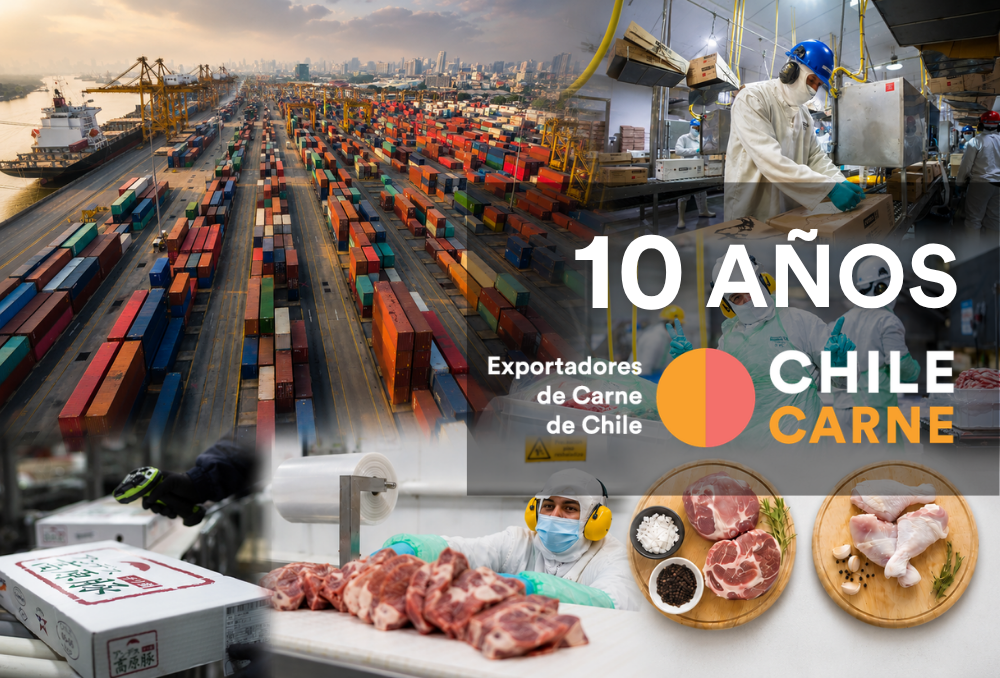
This month, ChileCarne celebrated its 10th anniversary of working to support the development of Chile’s pork and poultry export sector.
More than 25 years ago, the sector recognized that its future lay in its ability to export its products rather than rely solely on the domestic market for its growth.
With a population of less than 20 million and an open economy that allowed the import of products from neighboring countries—which had much higher output volumes and production costs that were difficult to match—it was extremely difficult to keep the poultry and pork production sectors afloat without running the risk of going out of business.
Two key factors made it possible for the pork and poultry export sector to develop. First, the free trade agreements that Chile signed with the world’s top economies gave us certain tariff advantages over other competing countries. Second, Chile’s natural borders provide us with unparalleled sanitary conditions, protecting us from the arrival of many of the diseases that afflict animal production today. These two factors, along with public-private collaboration and long-term thinking, paved the way for our products to reach more than 40 countries today. This has made Chile the world’s 6th-largest exporter of pork and 10th-largest exporter of poultry.
Over the past 10 years, ChileCarne has remained focused on these two goals: continuing to develop new and better markets for our products, and working with national authorities to continue protecting our health assets.
Opening up the Philippine market to our products, modernizing the trade agreement with the European Union, zoning agreements for Highly Pathogenic Avian Influenza (HPAI), and progress with ASEAN economies toward market access for our products are just some of our achievements over the past 10 years in terms of market opening.
When it comes to animal health and safeguarding our country’s health assets, it’s been an increasingly challenging task. As trade flows grow and the movement of goods and people across the globe intensifies, protecting our borders from disease is becoming more and more difficult. In addition, outbreaks of diseases affecting animal production worldwide have increased significantly in recent years, putting even greater strain on veterinary systems around the world.
Chile has been no exception, and we have faced the presence of HPAI in our territory three times over the past 10 years. Through coordinated efforts between the public and private sectors, we have consistently eradicated the disease in record time and thereby restored our status as a country free of avian influenza.
Strengthening the biosecurity of our production system, along with the ongoing monitoring and control of disease entry at our borders, has kept Chile free of the major diseases that currently affect pork and poultry production worldwide.
At the same time, the sector has had to face tremendous challenges in adapting its systems to move toward more sustainable production. Clean production agreements, participation in the Ministry of Agriculture’s Chile Conscious Origin program, and the adoption of new technologies to comply with the Ministry of the Environment’s new odor regulations are clear examples of the sector’s commitment to developing more sustainable animal production.
As we look to the future, the sector has some major challenges ahead. We must continue to improve production systems so that we can prevent the introduction of diseases that could affect both output and market access for our products. Improving biosecurity on farms, strengthening border controls, and conducting ongoing monitoring are key to addressing this challenge.
We must continue to expand into more and better markets for our products: ASEAN countries, India, the Caribbean, Africa, and the Middle East are markets where we should continue to focus our efforts. Strong health diplomacy will create better conditions for our products to enter key target markets.
We must improve our legal framework to make it easier to develop new projects that allow us to expand our product offerings and maintain our competitiveness relative to other countries. Legal certainty that establishes clear and consistent rules is key to the advancement of our sector. In this regard, land-use planning regulations will be key to ensuring proper zoning and the development of economic activities in rural areas.
We believe we can continue to support our country’s development, not only by contributing to local economies in the areas where we operate, but by supplying Chile and the world with products of exceptional quality that are produced in a sustainable way.