
As part of World Environment Day, celebrated on June 5, ChileCarne’s member companies highlight the progress they have made toward making their operations more sustainable. Renewable energy, water reuse, the circular economy, animal welfare, and various certifications are all part of a strategy that promotes increasingly efficient and responsible production. These strides speak to a sustained transformation that is strengthening the sector’s environmental footprint and its competitiveness in international markets.
Sustainability has become a driving force for transformation in Chile’s poultry and pork production and export sector. What was once mainly associated with meeting environmental requirements now takes a much broader view that embraces innovation, resource efficiency, circular economy, animal welfare, and responsible operations.
This transition comes in response to the many challenges facing global food production. The need to use water and energy more efficiently, reduce emissions, strengthen community relations, and meet the needs of increasingly informed consumers has prompted concrete changes at various stages of the production chain.
This transformation has seen ChileCarne’s member companies implement initiatives that have progressively integrated sustainability into the sector’s day-to-day operations, leading to measurable progress in various areas.
The results testify to this commitment. Today, 82% of animals are raised in systems with advanced manure and slurry treatment; 62% of total water consumed is reused or recirculated; the swine sector has reduced the intensity of its greenhouse gas emissions by 39% over the past 20 years; and 77% of the country’s pork production is certified under the Chile Conscious Origin program.
Decarbonization and renewable energy: Towards more sustainable operations
Reducing emissions and adopting renewable energy are part of the strategies that companies in the sector have implemented to move toward increasingly sustainable operations.
For this reason, Agrosuper has launched a number of initiatives aimed at transforming its energy mix and improving operational efficiency, with the goal of reducing its carbon footprint 13.7% by 2025. Currently, 77.8% of the electricity it sources from the grid comes from renewable sources, helping to reduce its greenhouse gas emissions.
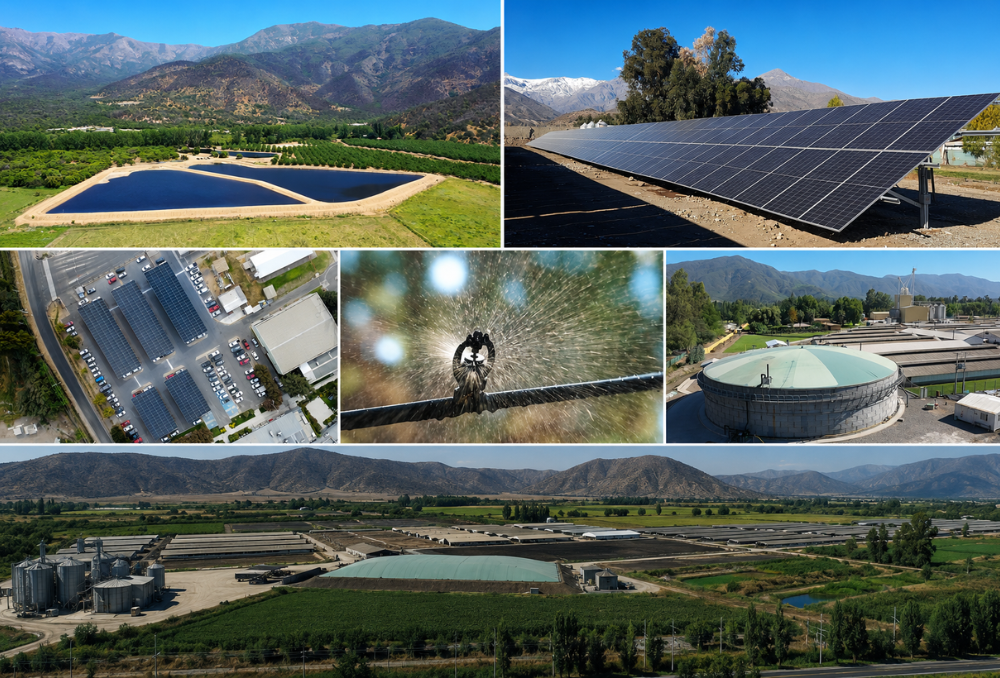
The company has also expanded distributed generation through solar projects at various facilities. These include a solar parking lot at its headquarters in Rancagua, which generated nearly 640,000 kWh in 2025 and supplied about 30% of the energy consumed by the facility and nearby industrial areas. In addition, the company has launched self-generation projects at 13 production facilities and installed heat pumps at its industrial plants—technologies that enable energy recovery, optimize resource use, and reduce water consumption.
Similarly, Agrícola AASA recently installed a photovoltaic plant at its Aguas Claras farm, equipped with 452 solar panels and a capacity of 240 kW. The facility generates about 40 MWh per month, and as a result, 36% of the energy consumed at the farm currently comes from a renewable source.
Water management: Efficient use of a strategic resource
Optimizing water use and fomenting its reuse are also part of the steps companies have taken to make their operations more sustainable.
In this area, Maxagro has developed a comprehensive strategy that includes seven operational biodigesters, systems for measuring water and carbon footprints, water reuse initiatives, and various projects tied to the circular economy.
One of its latest achievements was the installation of a system to recover water from evaporative coolers at the Las Pataguas slaughter plant. Thanks to this project, the company was able to increase water reuse by 27 liters per minute: a savings equivalent to the water consumption of more than 200 people.
The project illustrates how innovative production processes can yield tangible environmental benefits and optimize the use of a resource that plays an increasingly strategic role in food production.
Animal welfare: An essential component of sustainability
Animal welfare is now a central aspect of animal protein production and one of the attributes most highly valued by international markets.
In this regard, Coexca achieved an important milestone by becoming the first Chilean pork producer to obtain the Certified Care international certification for all of its breeding farms, its animal transport system, and its main processing plant.
Awarded by CloverLeaf Animal Welfare Systems, this certification accredits compliance with rigorous international animal welfare standards throughout the entire production cycle, strengthening traceability, continuous improvement, and best management practices.
This distinction shows how far the sector has come in incorporating sustainability criteria, which have become highly valued in global markets.
New standards and certifications that drive continuous improvement
Continuous improvement is also evidenced by the adoption of standards and certifications that strengthen environmental stewardship, traceability, and community relations.
One issue that has been the focus of much effort in recent times is odor management. This is especially true given the implementation of the sector’s first Chilean odor emission standard, which will take full effect in February 2027. Companies have been working to further strengthen their odor management systems, and ChileCarne has provided training, technical support, and opportunities to share experiences regarding this process.
At the same time, the sector has continued to adopt certifications that validate compliance with best practices in areas such as animal welfare, environmental stewardship, biosecurity, traceability, and community engagement.
Just recently, 118 pig farms had their certification renewed under the Ministry of Agriculture’s Chile Conscious Origin program, which now accounts for 77% of the country’s pork production. In addition, 27 poultry farms belonging to Agrícola Chorombo were certified under the same program’s poultry standard, consolidating progress toward increasingly transparent, responsible, and auditable production models.
Taken together, these initiatives reflect a transformation that continues to spread throughout the entire production chain. The adoption of renewable energy, efficient water management, waste recovery, animal welfare, and compliance with increasingly stringent standards are all part of a long-term strategy aimed at producing food in a more efficient, responsible, and sustainable manner.
Beyond simply complying with regulatory or market demands, these efforts are driven by a shared belief among ChileCarne’s member companies: that sustainability is fundamental to strengthening competitiveness, building trust, and ensuring the future of poultry and pork production in Chile.