


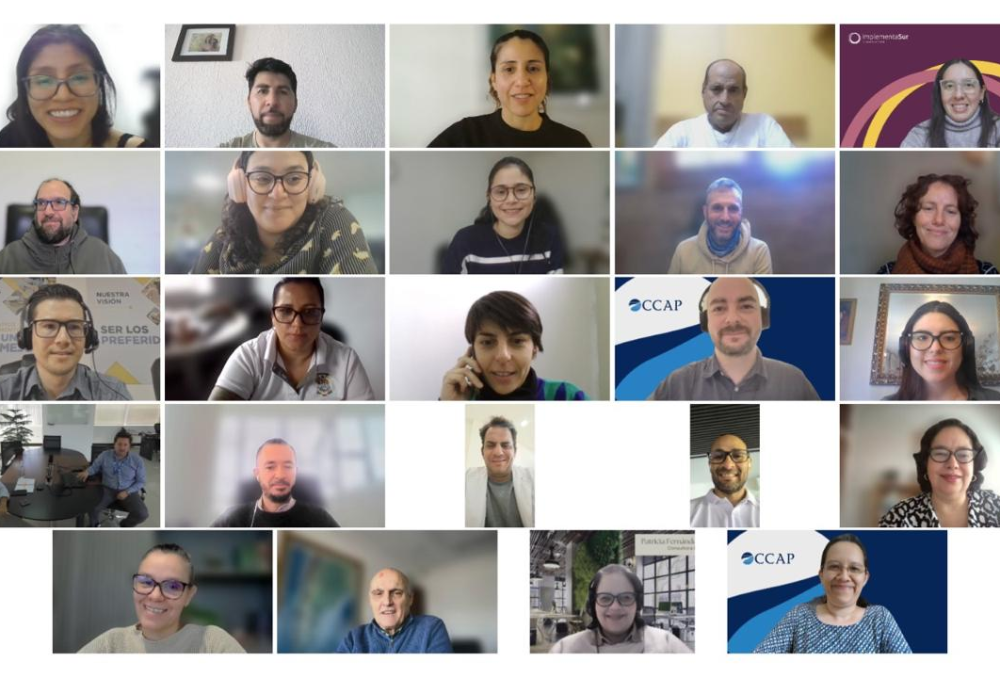
The use of by-products has become a key tool for moving toward more sustainable food systems and reducing greenhouse gas emissions. Against this backdrop, ChileCarne participated in the virtual session “From Waste to Resource: Value creation from by-products and methane mitigation in the meat industry,” organized by the Center for Clean Air Policy (CCAP), an international organization specializing in climate policy. The session was held with the MetLAC Community of Practice, a Latin American network that promotes the exchange of experiences and solutions for reducing methane emissions, of which ChileCarne is an active member.
The session, which involved the Chamber of Livestock Byproducts of the Buenos Aires Stock Exchange (Argentina) and the Costa Rican company El Arreo, was facilitated by teams from CCAP, LEDS LAC, and ImplementaSur.
The event, held on June 17, sought to share practical experiences in the utilization of organic by-products in food systems—both in the industrial and municipal contexts—and identify models of public-private cooperation that could be replicated to help reduce methane emissions in Latin America and the Caribbean.
ChileCarne was represented by María Ignacia Essedin, the association’s sustainability analyst, who presented the Chilean poultry and pork sectors’ experience in the use and recovery of by-products. During her presentation, she discussed the sector’s sustainability advances over the past 25 years with regard to the management of these products, the processes and technologies implemented to transform them into valuable resources, and the cooperation mechanisms that made this transformation possible.
Notable milestones include the evolution from the first CPA, which focused on basic slurry management, to Chile Conscious Origin, a comprehensive sustainability standard. In these 25 years of development, the sector has begun to adopt technologies such as biodigesters, which generate renewable energy using methane.
Today, 82% of the country’s pork production uses advanced treatment systems that make it possible to transform slurry into high-value agricultural bio-inputs.
Similarly, in the processing sector, 99% of slaughter by-products are recovered through rendering, where they are transformed into meal and oil for animal feed, ensuring that less than 1% of by-products end up in landfills. These initiatives help make more efficient use of resources, deliver economic benefits, reduce emissions associated with the management of organic waste, and extend the useful life of landfills.
The presentation also touched on other developments the sector has begun to pursue as part of a biorefinery approach, in which every part of the animal is utilized, including compounds of pharmaceutical and biomedical interest. The organizers highlighted the experience shared by ChileCarne as a case study of interest to the region, given its track record and contribution to sustainable solutions, as well as its replicability in countries throughout Latin America and the Caribbean.
When by-products become resources: Chile’s experience is shared with Latin America
Últimas publicaciones
-
 Biotechnology and meat production: Challenges facing the pork and chicken industries
 -
 Agri-Food Export Council addresses challenges and opportunities for agricultural exports
 -
 ChileCarne addresses new challenges related to dioxins, PFAS, and new contaminants at international meeting in Italy
 -
 ChileCarne works with the Ministry of Health to raise minimum temperature for frozen meat
 -
 Chile makes progress on health authorization in Indonesia, opening new opportunities for pork and chicken
 -
 Visit by U.S. officials highlights trade and production ties with Chile